
Cebu Travel Guide: Oslob Whale Sharks, Kawasan Falls and Cebu City
Cebu Travel Guide & Things to Do in Cebu
Hello! We’re picking up our Philippines series where we left off.
After Coron, the next stop on our two-week Philippines trip was Cebu, and on the road we said to ourselves: “Cebu is bad, but what’s around it is great!” You shouldn’t confuse Cebu the island with Cebu City in the middle of it, because however chaotic and noisy the city is, the rest of the island is just as beautiful and unspoilt.
Before we came, Cebu seemed a bit dangerous to us. Maybe because Magellan, on the voyage meant to prove the world isn’t flat, was killed here by the locals; the place clearly hadn’t left a great impression in our minds! Anyway, so much time has passed that we figured things had calmed down by now…
After three days in Cebu, we were sure it absolutely deserves a place on any Philippines itinerary. Cebu City is very ugly, but credit where it’s due: the rest of the island is really beautiful.
The real test is probably getting to Cebu 🙂
Getting to Cebu
We’ve said that getting from one island to another in the Philippines can be a struggle. So if you’re planning a Philippines itinerary, decide early how you’ll get to Cebu, because inter-island flights get incredibly expensive at the last minute.
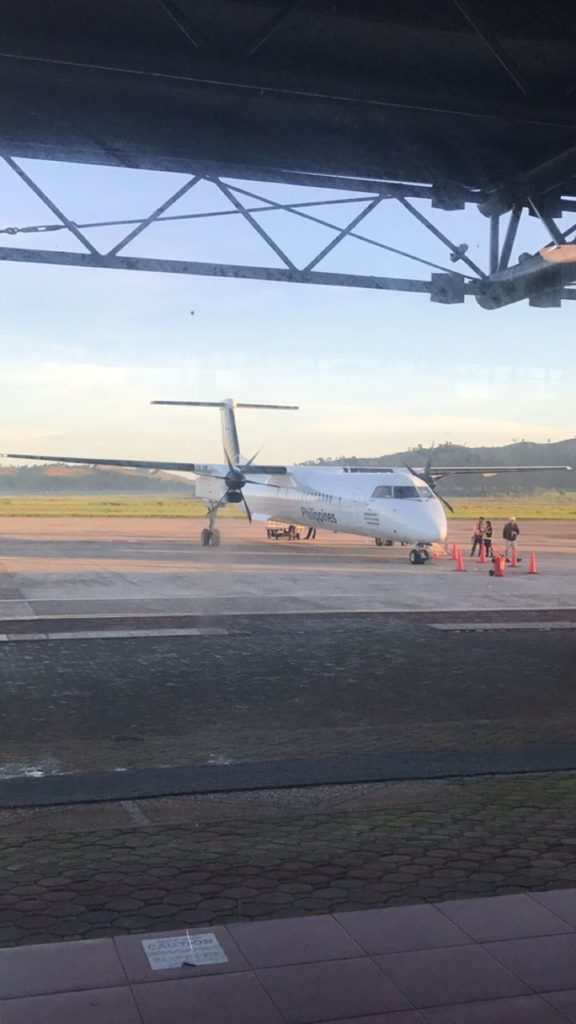
We flew from Coron to Cebu with PAL (Philippine Airlines) on a propeller plane. These inter-island flights are so laid-back that once all the passengers had boarded, they shut the doors and the plane took off 40 minutes early! The captain didn’t want to wait around for nothing, apparently. Our flight from Cebu to Manila was with Cebu Pacific and much more normal. We paid 70 euros per person one way from Coron to Cebu and 40 euros per person one way from Cebu to Manila. Book earlier and you can find cheaper fares.
Ferries also run to Cebu from other islands. You can check the 2GO and SuperCat websites.
Getting Around Cebu City
Unfortunately, Cebu City’s traffic is at least as bad as Manila’s, and distances are long. If you have time and want to use public transport, you’ll need to go to the Cebu bus terminal. We had limited time, so we chose the easiest option, taxis. We’d have liked to try the intercity buses the locals use, but travellers on annual leave don’t always have that luxury. 🙂 Between the places a tourist is likely to visit, a taxi is usually 1-2 USD, and from the airport to the city centre about 8 USD. Make sure the driver turns on the meter. (Grab also works well in Cebu.)

The most popular public transport in the city is the jeepney. It’s a really funny thing. Picture a vehicle with a roof but open sides and back. The story goes that the Americans left their wartime jeeps behind when they pulled out, and Filipinos converted them to carry passengers in the back.
In this people’s favourite, which can carry up to 20 passengers, you bounce along while listening to music blasting at full volume and wishing the people squeezed on top of you would shift over a bit! We think that, even if not every time, once you’re in Cebu you should ride a jeepney at least once or twice and enjoy the breeze in 35-degree heat, all packed in together; we loved it. 🙂 We paid 5 pesos each back then, about 10 cents.
Where to Stay in Cebu
There aren’t many tourist sights in Cebu City, so you can stay at any hotel near the centre; there’s not much you’ll miss in the city.
The “heart” of the city is Ayala Center. Sadly, the relatively rich big cities of poorer Asian countries are always full of shopping malls, and Cebu is a perfect example. Malls everywhere.
The centre is also one of the busiest parts of the city. If you want a central hotel, stay near Ayala.
We stayed at Hamersons Hotel, paying 35 euros per room per night including breakfast. It was very clean and the rooms were way above Philippine standards. It may have been our best hotel choice in the Philippines. We’ve left the link here; if there’s availability, run!
If you’re planning to go to Bohol the next day or take a ferry to another island, consider staying near the port, because even if you book a Bohol tour, you have to get from your hotel to Cebu Port on your own.
Things to See in Cebu City
It’s probably no surprise by now that Cebu City is no wonderland. But since you’re here, you can of course see the main sights. We set aside half a day for the city and it was enough.
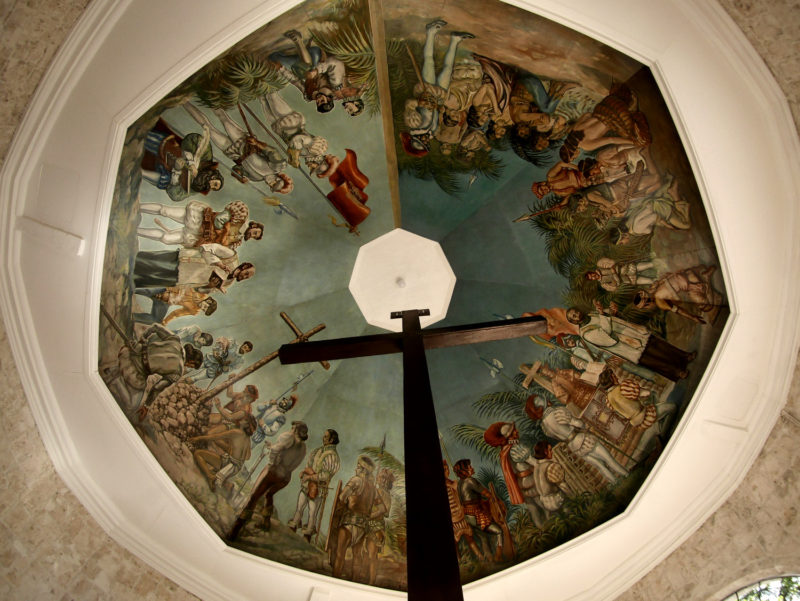
Fort San Pedro is a modest little fort in the city. The next stop, right nearby, is Magellan’s Cross. No, Magellan’s grave isn’t here. 🙂
Our next stop was the Basilica Minore del Santo Niño, the centre of Cebu’s biggest festival, the Sinulog Festival, held every January. When we visited, Sinulog was more than a month away and preparations had already begun. If you’re curious about the festival, have a look here.
If you want to shop, you can go to Ayala Center right in the middle of the city. But we must warn you: this mall is a bottomless pit! A total maze. How many floors, how big, how many shops, we have no idea. An unlovable place we entered at 3 pm and only found our way out of at 7 pm. If you love malls, though, we have to say it probably has every shop on earth. What we bought: a cheese sandwich, a vanilla ice cream and a pair of socks each… We really went wild, as you can see… 😛
Now we can start talking about Cebu’s beautiful side, the boring part is over…!
Two things brought us to Cebu: the chance to swim with whale sharks, and seeing Kawasan Falls. We absolutely had to swim with those whale sharks, no two ways about it!
Swimming with Whale Sharks in Oslob
Oslob Whale Shark Watching | Cebu
So what’s the story with these whale sharks? Are they really harmless?
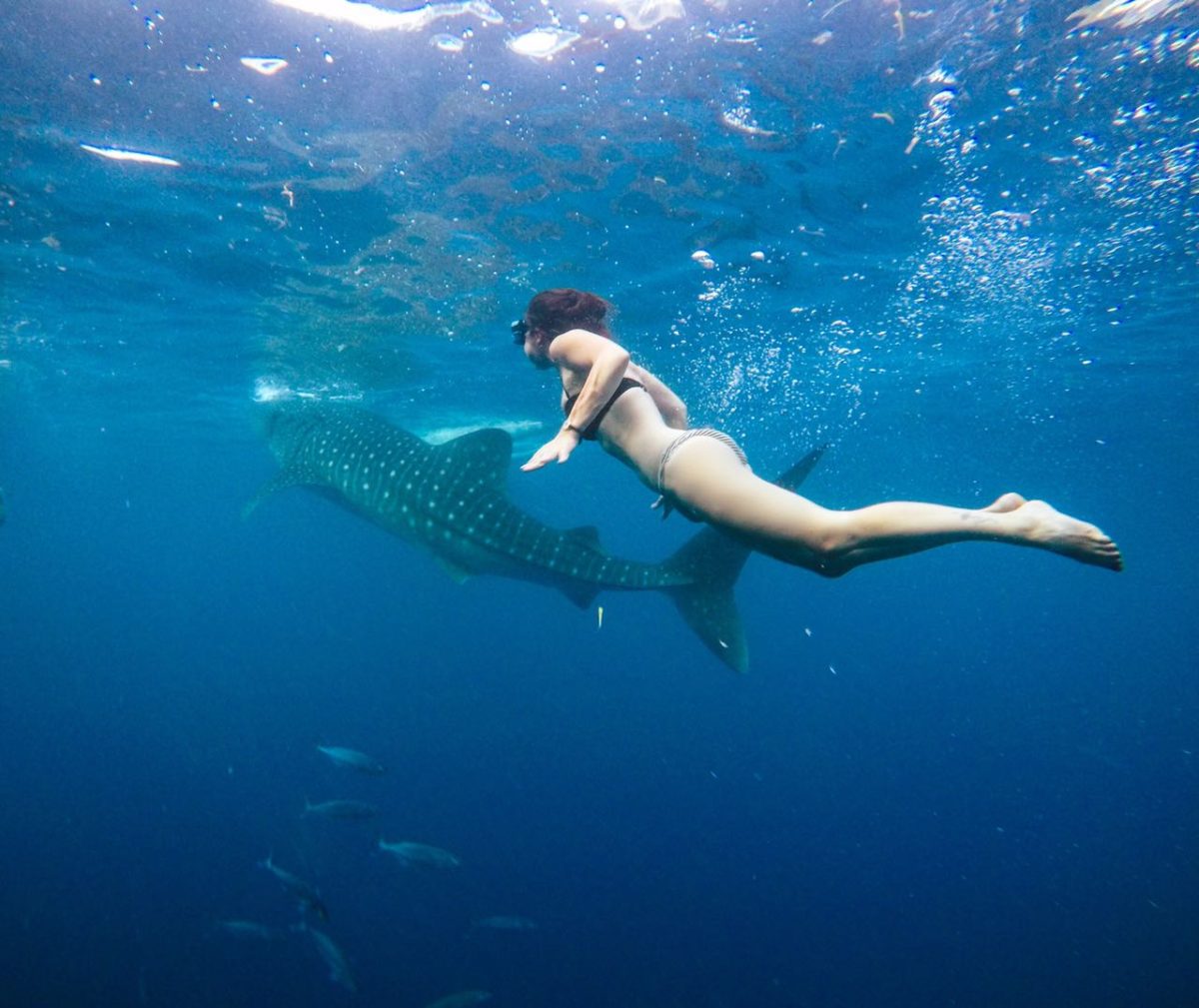
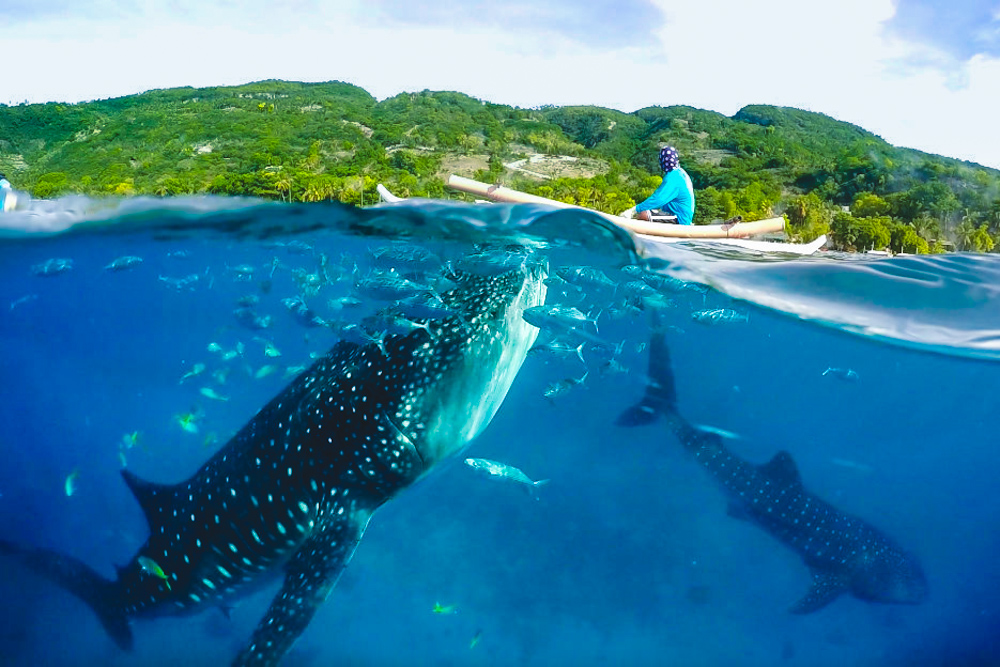
In the town of Oslob on Cebu Island you can swim with whale sharks, 5-6 metres long, in their natural environment! Whale sharks feed on plankton, so they aren’t interested in people and are harmless to us. Every morning in Oslob a number of whale sharks come close to shore, and because they’re harmless you can get in the water and swim with them! Of course you can’t just turn up and jump in; a tourist facility has been set up nearby, and you have to buy the whale shark swimming tour.
What won our hearts at the time was that the whale sharks aren’t in a cage or an enclosed area; they’re free and leave the area towards midday. They’re not locked in a pool and put on show for our entertainment. How many times in your life can you swim with a whale shark in its own home… This was the thing that excited us most on the whole trip…
An honest 2026 note: The whale sharks come to Oslob every morning because local boatmen hand-feed them krill, and marine biologists have long criticised this: feeding changes the animals’ natural migration and behaviour, and some get injured by boats. When we went, we didn’t know this. Today, if you want to see whale sharks, we’d suggest looking into non-feeding encounters, for example at Donsol (Sorsogon) in season or responsible operators elsewhere, and deciding for yourself. If you do go to Oslob, follow the rules: no touching, no sunscreen, keep your distance.

We read and researched a lot, and decided the most sensible option was a full-day private tour with an agency. There’s only one spot where you can swim with the whale sharks, Oslob, about 2.5-3 hours by car from Cebu City. You also need to be in Oslob by 5:30 am and ready to swim by 6:00 at the latest, so you can board the first boats without queuing and see the whale sharks before they leave. Arriving an hour late can mean queuing for 4 hours, and the whale sharks are only in view in the early morning. Some people apparently had to go back the next day just because they were late. For us this was the must-do of our Philippines trip, so we didn’t take any risks. You can stay in Oslob the night before and head to the site early, but since we were staying in Cebu City, we played it safe and booked a private tour for the day!
When choosing the tour company, we trusted the experience of people who recommended it to us and chose Ilink. It’s really important that the agency gets you to Oslob on time in the early morning. There were cheaper agencies, but you get what you pay for, and arriving in Oslob half an hour late means queuing for 4 hours and losing half your day, so we didn’t risk it. Sure enough, people who arrived half an hour after us queued for hours. We were very happy with our agency and recommend it.
The driver picked us up at 3:00 am, and by the time he dropped us back at the hotel it was already 7 pm. During the day we did Oslob whale sharks + Tumalog Falls + Kawasan Falls. Our private driver was with us all day, and we each had a private guide by our side. Breakfast and lunch at Kawasan Falls were included. We paid 5,100 pesos (100 USD) per person for this tour, including everything we did and all entrance fees. It sounds a bit pricey at first, but considering the experience, we think it was absolutely worth it 🙂
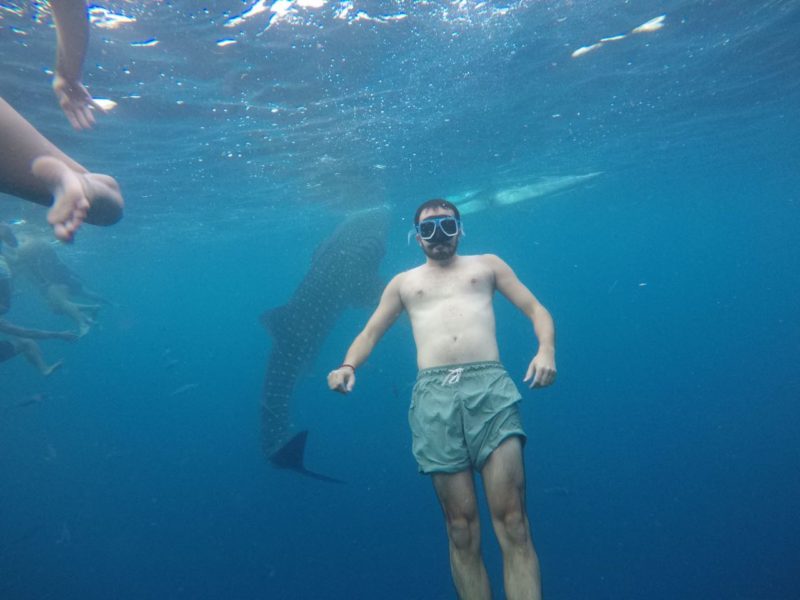
As we said, the driver picked us up early: we reached Oslob at 5:35 and had 25 minutes to get ready; at 6 sharp they start putting you on the boats. After about 5 minutes by boat you reach the spot where the whale sharks swim. Don’t be fooled by how calmly we’re writing this; we were so excited at the time!
Five minutes into the boat ride, something went “whoosh” past the side of the boat and we realised we’d arrived! After that it’s all adrenaline. We’d eaten meat the night before, so we must have been feeling brave, because we threw ourselves into the sea without hesitating! 🙂 At first we were a bit scared to get close, but then we convinced ourselves they were harmless and didn’t get out of the water for half an hour. We took loads of photos and videos with our GoPro. The boatmen also help you take photos. Touching the whale sharks is forbidden, but sometimes they touch you, don’t be surprised! Seriously, sometimes their tail brushes you as they turn; at first you flinch, but then you get used to it…
You’re allowed half an hour in the water, then you get back on the boat. There were 6-7 whale sharks around in total.
There are some rules. Sunscreen and flash photography are banned. On top of the tour price, if you get in the water to swim with the whale sharks, you pay the local operators 500 pesos (back then about 8 USD). They provide snorkels, but it’s best to bring your own. As we said, our guides had everything ready before we arrived, so it was easy. If you come independently rather than with an agency, swimming with the whale sharks cost 1,500 pesos (24 USD) at the time.
Swimming with whale sharks was one of our biggest motivations for the Philippines trip and something we’d dreamed about for a long time. Another dream had come true. Now we could happily carry on to our next stop, Tumalog Falls.
Tumalog Falls
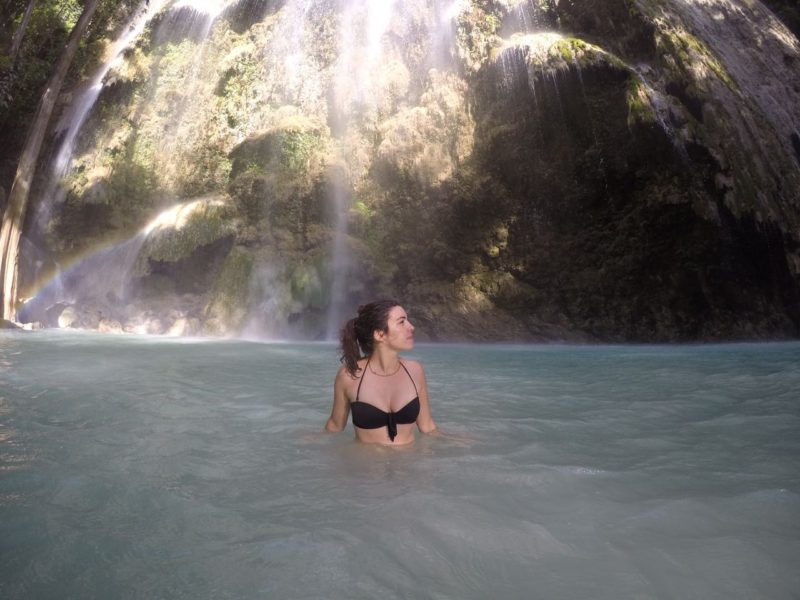
After the whale sharks in Oslob, we had a quick breakfast and drove 5 minutes to Tumalog Falls. The guide arranged by the tour was with us here too, and looked after our things while we were in the water. Maybe that’s normal on private tours, but it was our first private tour, so it felt very strange to us 🙂
Cars can’t get all the way to Tumalog Falls. For the last 500 metres you ride on the back of a motorbike, which takes 2-3 minutes.
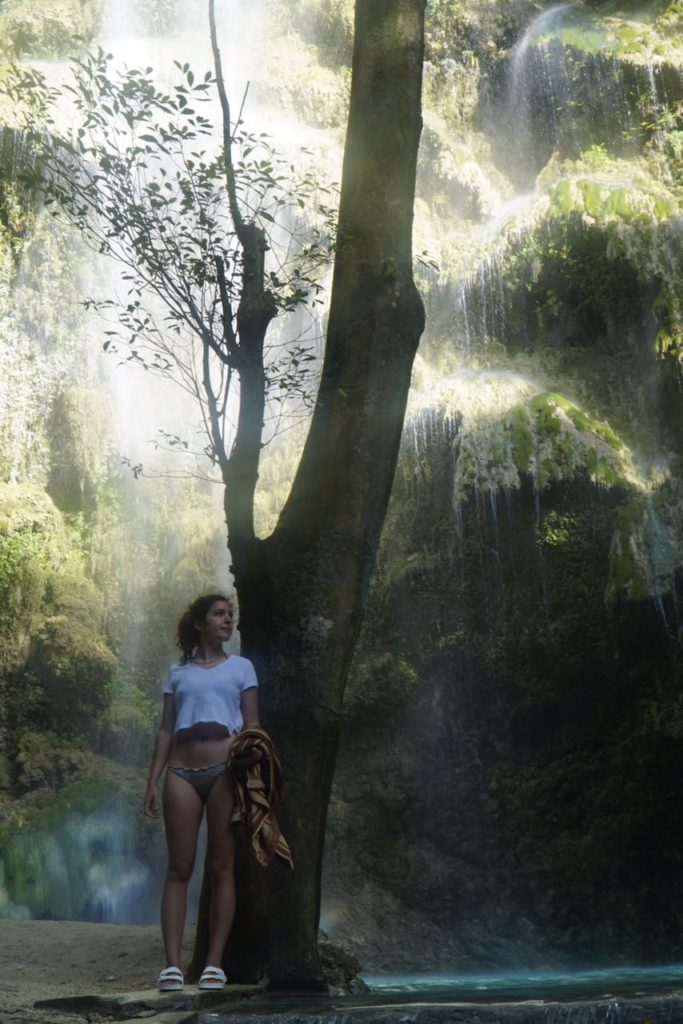
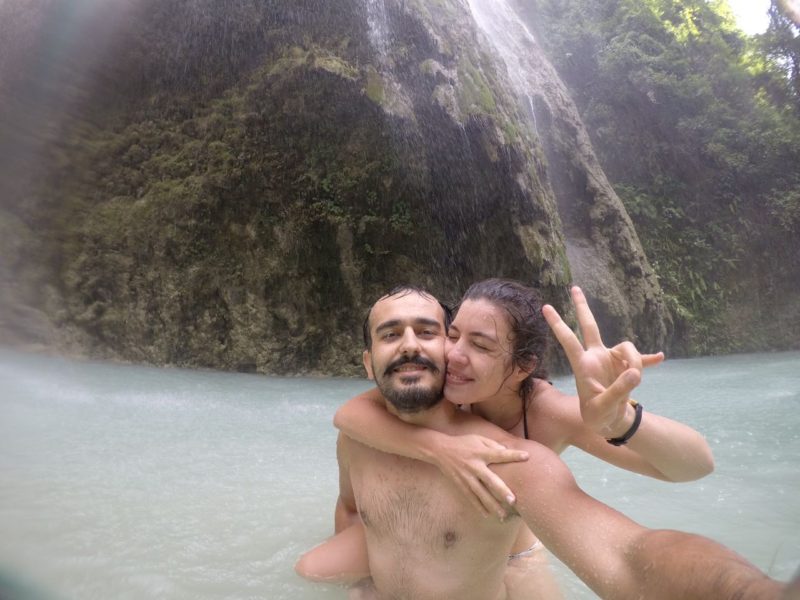
We’d swum with whale sharks an hour earlier and couldn’t slow down, so we threw ourselves into the waterfall too. We swam in the ice-cold water for about half an hour. When we got out, it wasn’t even 10 am. An early start really pays off…!
We loved Tumalog too; we think we love all waterfalls. Give us a waterfall and we’re happy.
Our next stop was Kawasan Falls. We said goodbye to our guide here and set off for Kawasan. Kawasan Falls is about 2 hours’ drive from Oslob. Time for a nap in the back seat.
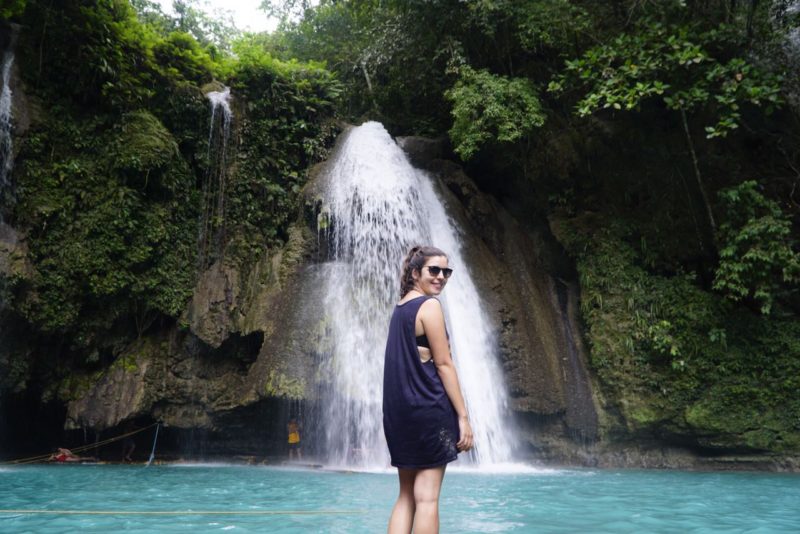
Kawasan Falls
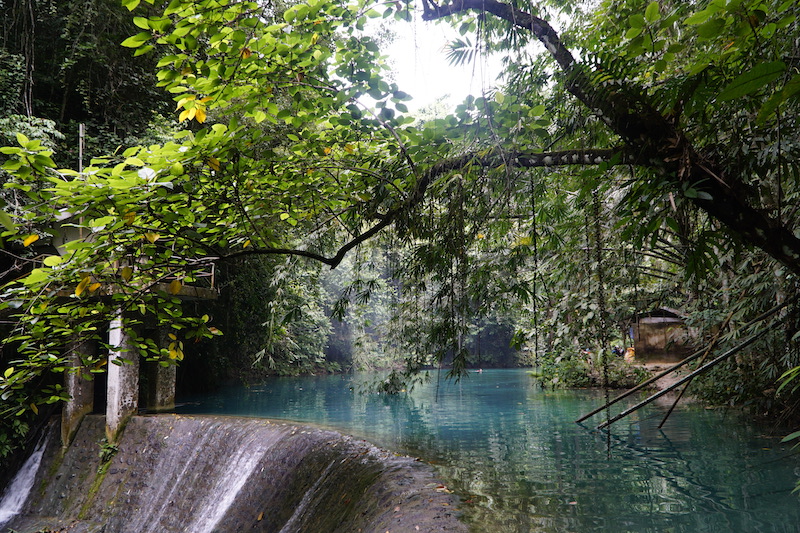
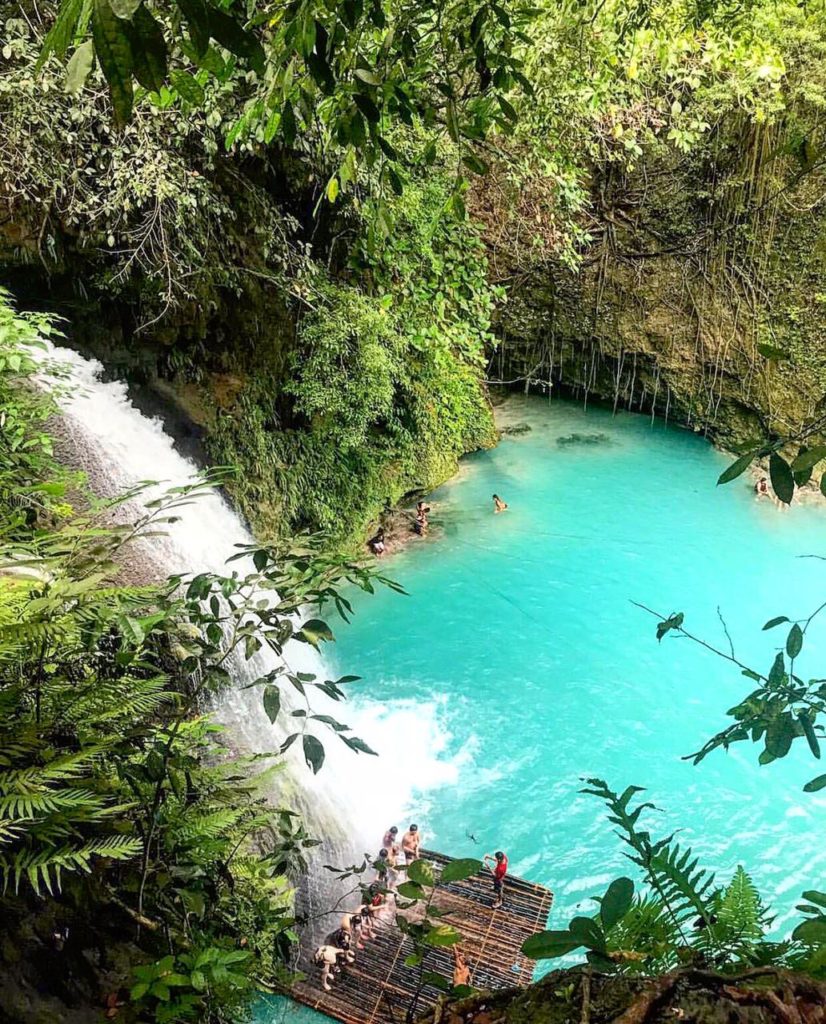
One of the top items on our Philippines bucket list was Kawasan Falls. We say Kawasan Falls because Kawasan isn’t a single waterfall. Think of it as a canyon spread over a large area with three tiers.
Entry to Kawasan was 50 pesos (1 USD) when we visited (it’s a bit more today). Inside there are three riverside restaurants with very reasonable prices.
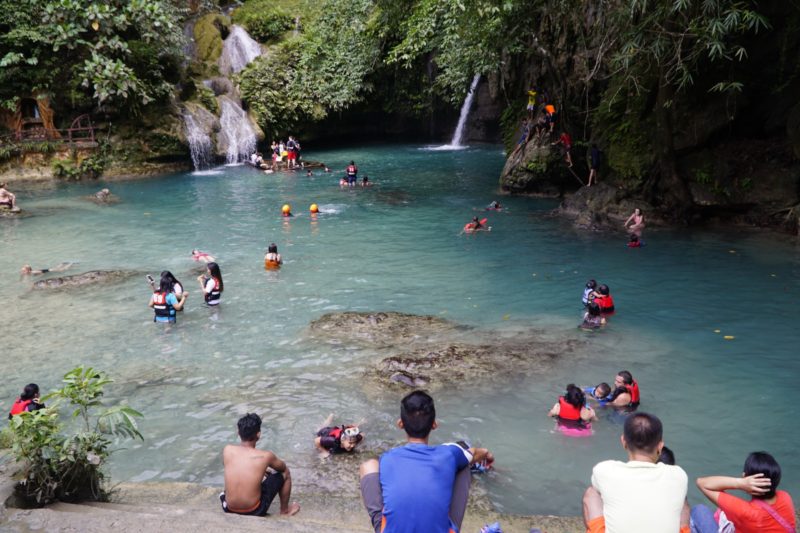
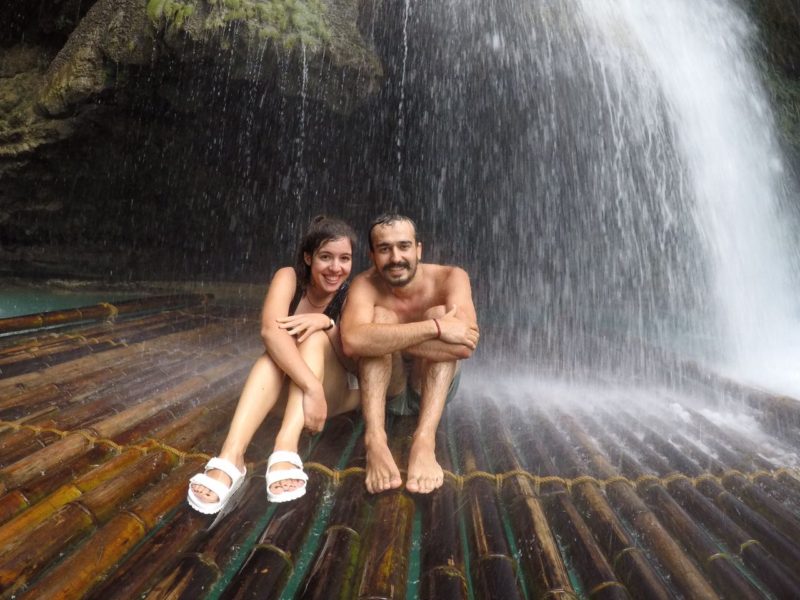
The Instagram photos you see online with the bamboo rafts and the waterfall are the first tier of Kawasan Falls, and if you catch it at a quiet time, it really does look exactly like that. But when we went it was a public holiday in the Philippines and the place was packed. We couldn’t work out what had happened to the peaceful waterfall in our heads, so we went straight up to the second tier.
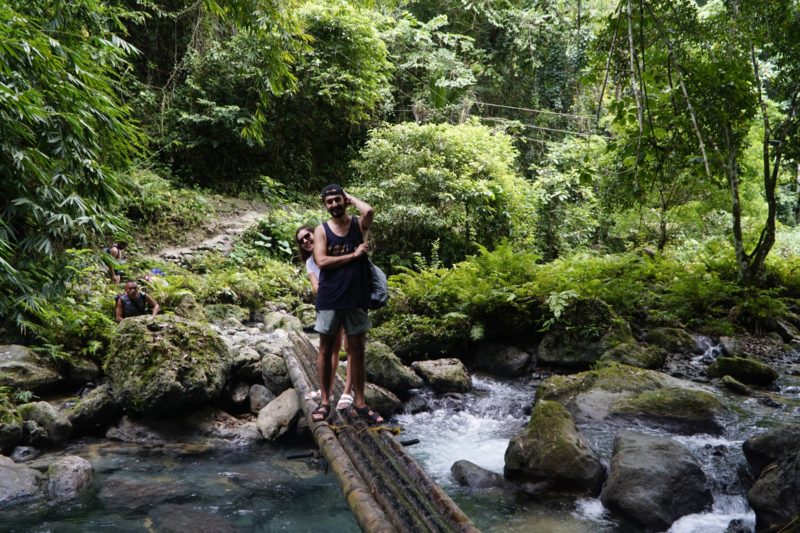
It’s about a 15-minute climb from the first tier to the second, and in our opinion the second tier is much prettier than the first.
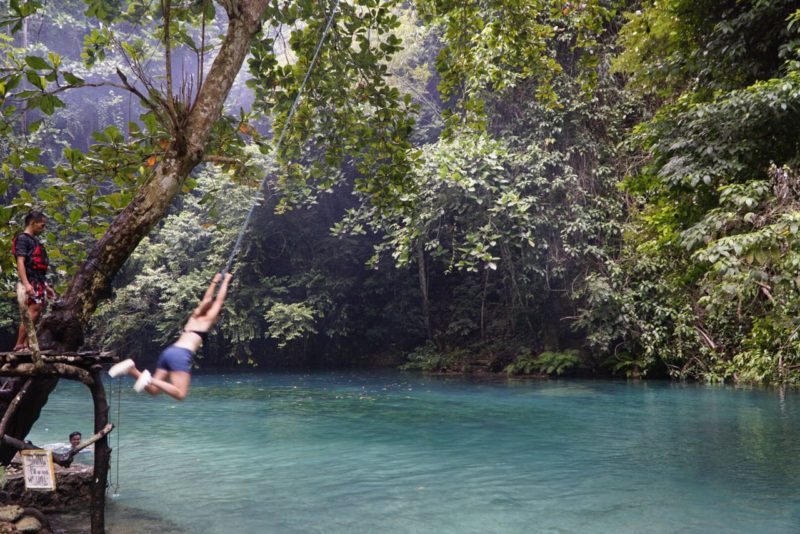
Another 15-minute climb takes you from the second tier to the third, and that’s where you discover all the fun is! It’s mostly young people up here, and the source of the falls is here too. People jump from about 15 metres into the gushing water. If swimming with whale sharks wasn’t enough, come and jump from here! We said we were feeling brave, right? We jumped! It was one of the most fun parts of the day.
Kawasan Canyoneering
For those who still need more adrenaline in the Philippines, there’s Kawasan canyoneering. They give you a canyon guide, and you jump off every ledge and swim through every pool in the canyon.
You can book canyoneering through a tour agency or at the office by the Kawasan entrance.
Kawasan was the last stop of our tour. We had lunch here and spent almost 3.5 hours at Kawasan in total.
The drive back to Cebu City takes about 3 hours. We slept the whole way and don’t even remember it. By the time we got back to the hotel it was 7 pm.
Now let’s talk a bit about where we ate and drank. 🙂
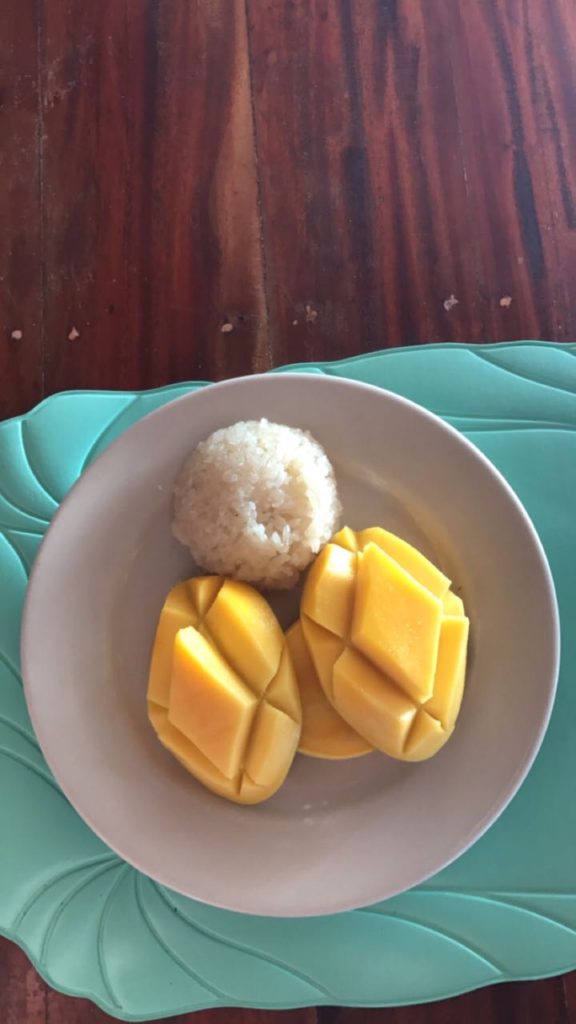
Where to Eat and Drink in Cebu
Cebu is a big city, so there’s a wide range of food and you can find restaurants of every cuisine. Eating where the locals eat is cheap, but touristy places are quite expensive. What we said about Coron applied here too, and we didn’t go into any of the places we thought were overpriced.
There’s a food court on the top floor of Ayala Center, and we had one dinner there. It was pretty cheap.
In Coron we met someone who came to Cebu about 20 years ago, opened a single kebab shop and turned it into a chain. He invited us to his wrap chain in Cebu, but we couldn’t fit it in. Later we found out it’s really famous, with reviews calling it the best kebab in the region. We regret missing it a bit; maybe you can try it.
Our favourite coffee place was Cafe Bo. We also really liked The Coffee Bean & Tea Leaf. Coffee Prince is one we noted down but didn’t get to.
We’d specially noted Cyma Greek Taverna because we wanted to try a Greek restaurant. When we saw that an average main course on the menu was about 16-18 USD, we didn’t go in, we just couldn’t! Many locals earn only a few dollars a day…
So that was Cebu for us. The city part was chaos, the rest was beautiful. With Cebu done, we bought our ferry tickets for Bohol and set off the next day.
For our Philippines preparation guide, click here.
For our Puerto Princesa travel guide, click here.
For our El Nido travel guide, click here.
For our Coron travel guide, click here.
For our Bohol travel guide, click here.
You can also find us on Instagram and Facebook 🙂
https://www.instagram.com/yoldabiblog/
https://www.facebook.com/yoldabiblog/
Lots of love!